Shortly after my surgery when I had tapped out my reserve of un-watched American and British tv, I decided to see what all the fuss of Korean dramas was. I was hooked. The problem with Korean dramas (other than being addictive) is that every single episode ends on a cliffhanger. The anatomy of my drama watching: watch one episode. Look at the clock and decide that maybe I should go to bed or be productive. Load the next episode on my computer so that'll be ready for the next time I want to watch. Eh, might as well watch 5 minutes so I'll find out what happened with the cliffhanger. Then I realize that I'm halfway through the episode. Well, I might as well finish the episode. Rinse and repeat until I've lost 6 months.
I'm using the excuse of improving my Korean to justify my bingeing. It's also making me incredible homesick for Korea, so I'm wondering how to swing a trip to Seoul next year. I also got my sister hooked on them as well (Sorry, Gwyn!)
Korean dramas are made of k-pop; overacting; crazy plot shenanigans like comas, birth/family secrets, classism including interfering parents, ghosts and other supernatural beings; and awesome, awesome shots of Korean food. The episodes are usually an hour long, with the entire series being 14-25 episodes. They are shown twice a week straight through, so they'll air for about 2-3 months. There is massive amounts of product placement in the show due to the fact many are aired without commercials. The turn around time is very short, with filming going for a few months before the show starts. Then film and airing occur at the same time, making the end of filming and the end of the show almost simultaneous. There is also not a strong actors union in Korea, meaning that actors are often underfed, underpaid, overworked and put in dangerous situations. Boys Before Flowers was an example of such problems, with three of the main actors being in car accidents and one minor cast member committing suicide because of the pressure. However, things are starting to get better as awareness and bargaining rights improve.
These are the dramas I've watched so far. I've written a short synopsis, my thoughts, and what I learned or relearned from the drama. All the photos are stolen from Wikipedia.
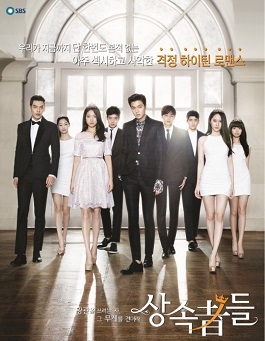
Heirs, or The Inheritors:
Synopsis: 17-year-old poor girl runs away to the US where she meets the illegitimate son of a rich family who falls for her immediately. He follows her back to Korea when it turns out her mother is the live-in family maid. Shenanigans ensue.
My take: Heirs will always remain one of my favourites by virtue of being the first one I watched. The production values were high and the acting was pretty good, making up for the angst, drawn out plot and repetitive soundtrack (I learned to hate "Love is the Moment" by 2am.) This is one of the ones I turn on if I need something in the background and every time I watch it, I notice something new (like this past time, I noticed that Rae El speaks low form to her mother- a big no-no.)
What I learned: How dramas work. Also, Korean guys can be hot. I learned how to say "You wanna die?" and "pervert" in Korean (both very important). Also, that the same word for "noisy" also is another way of saying "shut up." Also, the Korean school year starts in March with a summer break from mid-July to the end of August and a winter break from late December to January, and a 2 week break in February.
_poster.jpg)
Boys Over Flowers, or Boys Before Flowers
Synopsis: Plucky, poor 17-year-old girl accidentally gets herself admitted to a prestigious school run by one of the richest families in Korea (on par with Samsung). She catches the eye of the owner's son and his best friend. Shenanigans ensue.
My take: I picked this one because it had the same lead as Heirs (Lee Min Ho) and I figured that was easiest way to find the next drama to watch. This drama was full of the crazies. While having nearly the same plot as Heirs, it had a completely different feeling with being slightly cartoon-ish (it was based off a manga). The violence sometimes made me uncomfortable and I hated the heroine at the beginning, but the violence later became so fake and the actress calming down quite a bit. The soundtrack was pretty good and there was some awesome filmography of places like Jeju-do and New Caledonia.
What I learned: Samsung accounts for 17% of Korea's GDP. Crazy. Also, multiple seasons of a series usually translates to a less than stellar second half. Jjajangmyun, one of the dishes that I remember fondly from Korea is actually Chinese.

Flower Boy Next Door, or My Flower Boy Neighbour
Plot: Agoraphobic ghost-writer/editor, with an artist neighbour who is secretly in love with her, is secretly in love with a different doctor neighbour. Doctor's cousin comes to visit from Spain and crosses paths with her. Shenanigans ensue (sense a pattern?)
My take: This is one of my favs. Park Shin Hye won my heart in Heirs even if she sometimes was a little too passive, but I will forever be in love with Yoon Shin Yoon. Sadly, he enlisted in the marines this year, so I won't see him in any more dramas for at least two years while he serves his mandatory service. This one was refreshing because there wasn't anyone evil and the first without "jerky hero" syndrome. Seriously, sometimes I wanted to punch Lee Min Ho despite his good looks. This is Liam's favourite and he will sometimes ask to watch it even if he doesn't what's being said.
What I learned: The Flower Boy phenomenon. This is a tendency of younger men in Korea that wear their hair longer and make use of cosmetics. About 10% of men will wear make-up. To Westerners, they seem to be effeminate- as Justin puts it: "They're just too damn pretty" but it is the fashion. Personally, I see nothing wrong with young men putting thought into their appearance as they are usually well dressed and groomed.

City Hunter
Synopsis: After a secret mission to North Korea, the sole survivor steals the son of one his fallen comrades to raise to help him in his revenge mission against those that betrayed him.
My take: This one was AMAZING. Great soundtrack, awesome plot, kick ass fight scenes, and a heroine that will shoulder throw the hero when he annoys her. Violence usually isn't my thing, but this one was pretty cool, mostly because the hero didn't believe in killing unnecessarily and didn't like guns much.
What I learned: About the Rangoon Bombing. That the Korean equivalent of the White House is called the Blue House.

The 1st Shop of Coffee Prince
Synopsis: A tomboy gets a job for a spoiled rich guy who has to turn a coffee shop around. The owner starts to fall for the heroine despite thinking she's a he.
My take: Very cute. Little draggy, but totally makes up for it.
What I learned: 왕 (Wang) means king and 왕자 (Wang-ja) means prince. 사장 (sajang) means boss, as in the president of a company. It's what I now call Justin as our nickname for each other is boss. Also pour over coffee was invented in Japan.
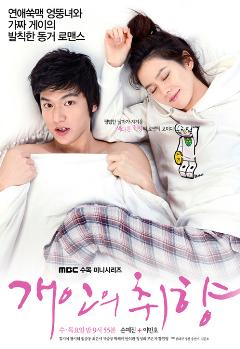
Personal Taste
Synopsis: Struggling architect moves into a hanok with a woman who has terrible taste in men. Due to a previous encounter, she thinks he's gay, which he's willing to go along with until he falls for her.
My take. Meh. Not the worst, but honestly, I only watched for Lee Min Ho. The antagonistic second female lead became tedious and by half way through, I started to wonder what could possibly be her end game. She just seemed evil for evil's sake. But the Director was sweet, and the two main characters were cute together.
What I learned: Korea's attitude towards homosexuality is slowly changing. According to the government, such a thing does not exist, but among the younger generation, they recognize it and also don't care. Weirdly, North Korea recognizes homosexuality may be congenital. Also, 개인 (Gae In), the main character's name, means both "clear day" and "personal" leading to a pun in the title. Personal Taste could also be translated to Gae In's Preference.

Playful Kiss, or Mischievous Kiss
Synopsis: A not-very-bright high school girl is love with the conceited head of her class who despises her. An accident causes the both of them to wind up living in the same house where he starts to have feeling for her.
My take: Honestly, I couldn't even finish this one. I abandoned it halfway through because I wanted to punch Kim Hyun Joong in the face, and seeing as how he's a nice guy in real life, he probably doesn't deserve it. Most the time when the hero is a jerk, there's a reason like a terrible home life or secret he has to keep. In this one, the hero was a just a jerk and the heroine was a anti-feminist sniveling idiot. I'll post some other day about feminism in K-dramas, but that's another day.
What I learned: The crazy hours that Korean students will keep studying. I actually knew this already, but something about high school students being at the school until midnight being the norm was a little weird to see. It's actually gotten better with the abolishment of Saturday school. Also, the room where the noodles were dried was the only good part of this drama.
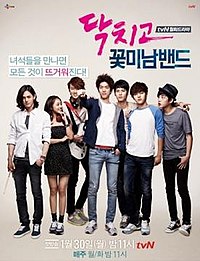
Shut Up Flower Boy Band
Synopsis: High school misfits form a band and hit it big. However, navigating the show biz and high school worlds may be too difficult.
My take: Despite the name, this show was rockin'. The music was definitely the highlight of the show, but the plot was sweet and characters realistic. The pacing was also quick and didn't drag. One of the best I've watched so far.
What I learned: Show biz in Korea is interesting. With so many child stars and a surge in the Korean Wave, agencies will provide dorms, personal managers, and training to their signees to keep them under their thumbs. Also, the Busan accent is really hard to understand.

My Girlfriend is a Gumiho, or My Girlfriend is a Nine-Tailed Fox
Synopsis: A Gumiho, or a nine tailed fox, escapes the painting holding her prisoner and ends up entangled with a selfish wannabe actor who has no choice but to help her become human.
My take: This was my first foray into the Hong sister, a comedy writing duo. I loved it, and Justin even liked the parts that he watched. That being said, this show required A LOT of suspension of disbelief. The fantasy element is never really explained, and the ending is just kind of thrown at you in a drive by delivery. I could never really believe the second male lead was much of a contender either, and I didn't really care about anyone outside the main couple.
What I learned: I learned what a gumiho was. Also that rain with a sunny sky is known as "fox rain" in Korea. I remembered the word for "goblin." I finally learned the sino-korean numbers, something that I'd had a block on for a while and now that I know it, I wonder why they don't use it for everything. Korean has two counting systems, Korean and Sino-Korean, which is Chinese. The general rule of thumb is Korean is used for small quantities and Sino-Korean is used for larger (20+). Like hours are counted in Korean, but minutes are Sino. Not confusing AT ALL (grrrrr).

King of Baking, Kim Tak Goo, or Bread, Love and Dreams
Synopsis: Whiny small boy with great sense of smell grows up to be Yoon Shi Yoon. His father's wife, wife's lover, and his half brother are out to get him in 25 LONG hours.
My take: 25 hours of my life I want back. I started to watch for nostalgia's sake because this show reminded me of the old Korean dramas I used to watch with Gwyn and our maid/baby sitter Mi Suk, complete with overacting and hyper synthetic violins. However, nostalgia wasn't enough to get this plot moving, and lack of humour make this a slog that I only endured through because of Yoon Shi Yoon. And only just barely.
What I learned: 빵 (bbang) is bread, and 방 (bang) is room. 봉빵 (bong bbang) plays a part in this show, which is not to be confused with 붕어빵 (bungeobbang) which is a bread shaped like a fish and filled with red bean paste. Also, how to make rolls that look like flowers. And tak goo is the name for ping pong in Korea because it's what the paddle hitting the ball sounds like. Other than that this show was a bust.
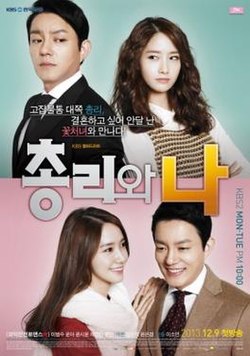
The Prime Minister and I
Synopsis: Down-on-her-luck tabloid journalist accidentally gets into a scandal with the newly appointed prime minister and the only way to save themselves is enter a fake marriage.
My take: Cute, but draggy and the ending was meh. The synopsis makes it sound very potentially predatory, especially due to the age difference between the actors, so I breathed a sigh of relief when getting married was her idea, and both parties agreed equally.
What I learned: The President in Korea is elected, but the Prime Minister is appointed. And the kids's names together: Woori, Nara, Mansei translates to "Our nation, hooray!"

Emergency Couple
Synopsis: Bitterly divorced couple wind up doing their medical internship in the same emergency room.
My take: I liked this one. There probably wasn't as much personal grow as there could have been, but it was cute and I'm love with Choi Jin-Hyuk (I've falled in love a lot the past six months). However, the entire cast was endearing, and Justin like Chief Gook.
What I learned: Marriage in Korea can be symbolic only. The marriage isn't considered "official" until it's registered with the government. This sometimes was held over the bride's head as mothers-in-law threatened to not register the marriage until the wife produced a child. Medical schools are also direct entry, meaning that you do not need to have an undergraduate degree first.

Bride of the Century
Synopsis: Rich boy's family supposedly is cursed by a ghost that causes the first wife of the family heir to die. Heir's fiancee runs off and is replaced by the bride's family by a woman who looks exactly the same. Guess which one the boy falls in love with.
My take: So I mostly like this one. The answers were slow coming, and when they did, it was mostly WTF? But it kept me interested enough to enjoy it.
What I learned: 같인 (gat eun) means same. However, 같인 (gat eun) when spoken is usually said 도같은 (do gat eun) which sounds a lot like 돜같은 (dok gat eun) which means identical. Which becomes the point that I curse the Korean language and say that's cheating. Also, 군고구마 is a roasted sweet potato sold at night in the winter. I never had it in Korea (because I was never out late at night on the street) but it sounds really good and I'm trying to figure out how to make it in my oven. Also learned the Korean word for ghost, 귀신 (gwishin) literal translate as "strange deity." Also Lee Hong Ki sang the main theme for Heirs.

Flower Boy Ramyun Shop
Synopsis: Spoiled rich boy becomes obsessed with a teacher at his school who quits to take over her father's ramyun shop when he died.
My take: This one had me rolling on the ground. I still think she picked the wrong guy (Hello, when presented with two guys, you always take the tall, hot one that can cook! And is totally in love with you!)
What I learned: Teachers have to pass a pretty brutal civil service exam. Also learned about the legend of Prince Hwanung, who founded Korea and later married a bear. "Gun" is a modifier to a name of someone who is important. Manhwa is the Korean version of manga. Makjang is a word that means plot device often seen in dramas, much like a cliche or soap opera.
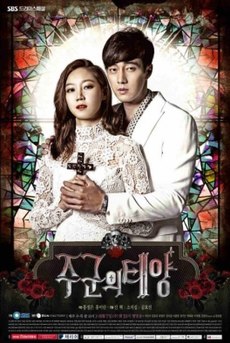
Master's Sun
Synopsis: A woman who can see ghosts discovers when she touches the rich president of a mall, the ghosts vanish. He wants to use her to locate his mother's necklace in a kidnapping scheme gone wrong several years before.
My take. This and My Love From Another Star are my current favourites. It was this one that really sold me on the Hong sisters. Again, suspension of disbelief was needed, but the plot holes were small, and the chemistry between the main couple had me fanning myself a couple of times.
What I learned: The title is a pun. The hero's name is Joo Joong Won, but everyone refers to him as 주군 (Joogun), Joo + gun, a name modifier for a male who is above you. Joogun also means "master" and Joong Won means "supremacy." The heroine's name is Tae Gong Shil, but people refer to her as 태양 (Taeyang), Tae + yang (the female version of gun) which means sun. Gong Shil literally means "empty room." So the title is a pun meaning either "Master's sun" or Mr. Joo's Ms. Tae. It's cute. Also learned that "gong" means empty in addition to meaning zero in Sino-Korean. I also learned I'm in love with Gong Hyo Jin, and to a lesser extent So Ji Sub. But mostly I'd go gay for Gong Hyo Jin.
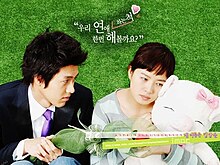
My Name is Kim Sam Soon, or My Lovely Sam Soon
Synopsis: A (slightly) overweight pastry chef is dumped by her boyfriend and fired from her job on the same day. She crosses paths with a restaurant owner who hires her not only to be a pastry chef, but also his fake girlfriend.
My take: I quit this one halfway though. I don't know if it was the jerky hero again, or the fact that this was an older drama that didn't quite grab me. I'd kept hearing that this one one of the classics, but the complete lack of chemistry between the main characters kept me from believing it. Maybe it was timing because I watched this right after Master's Sun, but I didn't really think either party was into the relationship.
What I learned: What a "madeleine moment" is. It's an involuntary memory triggered by sensory input. Coined by the book, In Search of Lost Time by Marcel Proust. Also, some dramas are totally overrated.

You're Beautiful, or He's Beautiful
Synopsis: A nun in training has to masquerade as her rocker twin brother after a botched surgery. Unfortunately, she falls for the leader of the band.
My take: Cute, light, good music. I was glad she was outed as a girl fairly early because it let the romance get going without the weirdness. Also because Park Shin Hye as a boy is completely unbelievable as she's cute as a button and has a voice only rivaled by castrated Vatican choir boys.
What I learned: Kalguksu (knife cut noodles) is a noodle soup. There's an alley in Namdaemun that's full of kalguksu shops that's now on my want to do list.
To be continued because I'm tired.


